EPISODE 2
Available on:


TRANSCRIPT
What Do the Yogis Know?
Sometimes the plot twist isn’t the crisis. It’s the way you’ve been holding your body like one is always coming. It’s what I do. And call it free living. Not in the moment. Always anticipatory. Episode two plot twist is what do the yogis know? And it’s about bracing, about living in fighter flight so long it starts to just feel like your personality.
The tight jaw, shallow breath, the always ready nervous system that’s confused. Preparedness for safety. In this episode, we’re going to talk about what those yogis have been whispering for centuries. You don’t force your way or think your way into calm. You have to signal your body there through breath. A quiet downshift back towards your parasympathetic nervous system. You know what?
That’s actually back towards yourself. Not a perfect serenity. Not a new identity. Just a little more space inside your own skin. If you’ve been surviving by holding your breath like I have, then this one’s for you. The twist. It’s you. Some of us are not out there living our lives. We’re doing what I like to call some pre living.
That’s right. Pre living till we get to the next problem. That’s because we’re in a constant state of bracing unconscious bracing which is its own unique flavor. Bracing is a form of hope distorted by fear. Here’s what it says to me. Maybe if I just prepare enough, this is going to hurt less. We’ve all gotten so good at bracing that the body doesn’t even know the difference between a current threat and just being stuck in an old pattern.
Bracing is what happens when your system starts living one moment ahead of your life. Your nervous system. Learn this from your own history. Downshifting is coming out of emergency mode long enough to remember who you really are. Plateaus is a podcast for the space between what you planned and what’s actually true. Offering grace so you can take what’s yours.
Leave what’s heavy and the twist it’s you. Tomorrow I’ll send a digital postcard like paper. Just a sentence or two to meet you wherever you are. Welcome to. What do the yogis know? I’ve never aspired to be a Yogi. I have complete respect for all of those of you who already are or are aspiring to become a Yogi.
But I’m not going to lie. There are some really, really great benefits that I want. What they got, I want, and here’s my list. Improved mood and mental clarity. I want that less stress and anxiety. Sign me up. Improved energy. Yes. Better sleep. Mindfulness. Recentered and enriched overall wellbeing. Including mental. Yes. Yes. Yes. All of the above. But what if the reason that you and I can’t relax isn’t because we’re just bad at relaxing?
Have you ever noticed when you finally settle down to rest, your body just doesn’t. Maybe the yogis know that the body often can’t think its way into safety. Sometimes it has to breathe its way there, move its way there, repeat its way there. This is about the quieter thing underneath it. The possibility that the body knows how to hold on, and that it also knows how to let go.
But many of us have become so incredibly fluent and holding on that letting goes feels foreign or not even like an option. Maybe that’s what the yogis know. Maybe they know that some of us are tense, not because we’re doing life wrong. Maybe we’re tense because somewhere along the way, tension became rebranded to loyalty to ourselves. Protection. Preparedness.
Love. Competence. Survival. Not to brag, but I do consider myself in the top tier of all bracers. I feel that locally here in Chicago. Nationally for the United States, I. I would even go up against global competition on bracing. Bracing is not a character flaw, and it’s also not a personality. It’s a protection program. Softening is a physical shift, and the reason it’s hard is not because you’re bad at healing.
It’s because your body has reasons for not wanting to let go. So I wanted to know more what is happening when we’re bracing. Bracing is the mind and body preparing for impact before it arrives. Moving into a state of anticipation when some part of you has learned that it’s safer to expect disappointment, conflict, loss, overload, criticism or rupture, then to be surprised by it.
It’s not just fear, it’s organized fear. It’s fear with an actual strategy. Bracing can take many, many forms. It can look like overthinking. Over preparing. Over functioning. Reading the room. Staying productive. Staying useful, and staying one step ahead. And from the outside, those people are looking in on you. It can really appear pretty fantastic. You’re the reliable one. Composed the self-aware one.
The one who just handles things from the outside. It can look like capability and competence, while on the inside it feels like never fully setting your bags down. My partner observed this in me for many, many years and he actually came up with a nickname for it. He called it The Machine. That’s right. There is even theme music for it.
I’m going to be trusting here and go ahead and let you in on it. The machine. BR br br br br. You get the drift. He literally would give me the name of the machine and the theme music to help clue me in that I was bracing that I couldn’t downshift. You know the best part about this? I completely missed it.
The deeper psychological reality is that bracing is off in an attempt to reduce pain by meeting it early. If I expect a letdown, maybe it’ll hurt less if I tighten before this hard thing. Maybe I can control the blow so bracing is not irrational. It’s very intelligent. The problem is, it’s expensive. My psyche had decided it was better to live prepared than to live.
Surprised, bracing then shows up, for me, at least as a texture in the body. I can’t describe it, but it’s always there, like a low hum that I can’t place. But it’s so annoying. I knew it was there, but I didn’t have a language for it. It was my tight jaw, a clenched stomach, shoulders that basically were touching my ears.
A chest that never quite completely could exhale. I felt tired, but I could have braced. Ever wired but heavy. Alert but foggy. It felt like holding my breath. But technically I knew it was breathing. I was always on. Sometimes it can feel like restlessness, irritability, insomnia, shallow breathing, muscle tension, headache, digestive issues, sudden tears. Oh, those sudden tears and difficulty concentrating.
Or I think the sneakiest way is that, strangely, the ability to enjoy something while it’s happening because part of you is already scanning for what it could interrupted, can also be much more subtle. It can feel like not letting good news all the way in, like receiving love with one hand and keeping skepticism firmly in the other. Like sitting on the couch while your body behaves as though it is still in a meeting.
That was a classic move of mine. A place where relaxing came with consequences. Consequences? I already knew I’d have to pay. Bracing just feels like your body is waiting for a cue that never quite arrives. Telling it you can come out now. It’s safe. So what are the yogis always say? Allow yourself to soften. Softening is not becoming passive.
It’s not collapsing. It’s not checking out. It’s biologically. The body’s shifting out of constant mobilization and into enough safety to go into the downshift. When the nervous system gets the message that, hey, this is the moment you don’t need to defend sprint grip, anticipate, or perform. It’s the body moving, even if it’s briefly from alarm towards repair. Softening is very simple and very profound.
The exhale gets longer. The jaw loosens the gut. Unclench is heart rate. Settles your shoulders. Drop your eyes. Stop scanning. Your body begins to allocate energy towards those things: digestion, restoration, connection and presence. Instead of just pure protection. This is what the yogis know. That practice is like breathwork, stretching, and meditation. All of it can help. Not because they make you a better person, because they create conditions where the system can remember.
There is more than one gear. Softening. Is not your body giving up. It’s your body realizing it doesn’t have to keep guarding at this moment. Honestly, I did not know. I’m telling you that there were other gears. I had been in whatever gear I was stuck in for so incredibly long. I didn’t know you could downshift. I didn’t know it existed.
Was there a manual? How did you do it? Where? When? So for me, bracing became a way of being instead of a temporary response. And then my body paid for living like a thread was always there. My muscles were so contracted, my breathing super shallow. I don’t want to even know if there are checks on my stress hormones.
What level of those are circulating? That’s how it was. Sleep. Oh, it wasn’t restorative. I was never offline. My concentration got harder because so much energy was being used. Monitoring and managing pleasure was harder to access. I was so busy in my nervous system trying to keep my perimeter safe. I felt like my Scottish terrier, Duke. Every time he goes outside, the very first thing he does is secure the perimeter.
He doesn’t play. He doesn’t relax. He can’t do anything until he literally takes every single step along that fence line. Secure the perimeter. Duke and I are not so different. Actually, maybe we are. I think he knows what he’s doing. Over time, brazing can make us feel disconnected from our own bodies. You stop noticing what it feels until it’s allowed inside you.
You start relating to your body as something you must force. Drag optimizer. Override. An emotionally bracing really narrows life containment. Constriction. It can make tenderness harder to tolerate. Joy harder to trust. Stillness harder to access. It can keep me alive. Functional, admired even. But at the same time, it cuts me off for so much of the beauty. Why is softening feels so uncomfortable?
I literally get the ick. No one told me it wasn’t going to feel good. We need to know this. Tell us, why is this such a secret? Because what I started to think is I was doing it wrong. Failing at it. And now I realize, no, I was doing it right. I was, like, crushing the thing. But it made for me.
I felt more anxious. It was unfamiliar territory. My system didn’t like it. Okay. It had been organized around preparedness and softening. Felt like, I don’t know, we were putting down our shield and we didn’t know if it was safe. Tension was costly, but I also loved it. It was familiar. It was my bestie, my companion, literally by my side.
Me in that tension. It was part of my identity. It gave me a sense of purpose and control. There’s another thing nobody tells you about softening. Softening is protecting things underneath you don’t want exposed. I want you to soften. Spoiler alert they’re all revealed, even if it’s just to you. Grief. Fear. Anger. Fatigue. Loneliness. Disappointment. The body wasn’t just holding this tension against the outside world, but against your own inner demons.
So I guess the hidden truth here is that softening can feel strange. And of course, it can feel vulnerable. It may be the first time in a long time that your body is not busy enough to keep everything muted. So sometimes softening feels unfamiliar. Not because you’re doing it wrong, but because your body has so much more practice protecting than receiving.
When you stay moving mentally, emotionally, and physically. You don’t have to fully feel. You don’t have to fully notice. Motion is such a great disguise. You get the illusion of control. It makes you feel ahead of the things that might hurt you. It can make you feel useful. Safe. Necessary. Defended. Slowing down. It interrupts this autopilot setting. And when the pace changes, your body may suddenly register everything it’s been carrying.
All those unfinished feelings, the accumulated exhaustion that vulnerability underneath the competence. The grief under productivity. The fear under control. So that’s why I just relax and can cause such a visceral response in the body. Because for some nervous systems, slowing down is not felt as self-care. It’s purely felt as self risk. That’s how it felt for me. Living dangerously.
Softening rhythm or the pace of you also has to slow down. Speed is likely been a part of the survival strategy. Bracing for me looked like competence. Staying ahead, reading the room, managing tone, anticipating needs. Getting there first. And I’ll tell you, it showed up beautifully at work. So I had a great job at a consumer packaged goods company where we made dog food, cat food, treats, litter.
Great place to work. So one day my boss comes in. He’s an awesome guy, laid back, smart, kind, everything you could want in somebody to work for and with. So he sits down and says to me, hey Christine, I know this may come out of left field for you, but we think you need to get a hobby. If he could have heard my inner voice, I was like, I’m sorry, sir.
A hobby. He then goes on to tell me I’m doing amazing work. My dedication to the organization is tremendous. The amount of hours I work, my dedication, my thoroughness, my creativity. All great. But that I needed a hobby. And that whatever hobby I chose, it should require me to leave the office at 430 to 5:00 a couple days a week.
If I wanted. He was willing to help me learn to golf. He was an avid golfer. If I wanted to start powerlifting not just for sport, but for competition, that was great to get a hobby. What is happening here? I’m doing everything right. I couldn’t tell then, but just like my partner in the machine, this person, my boss is trying to tell me to downshift, to breathe, to become more fully me, to rest.
I missed it. Now we have two places. It’s govt and I missed them both completely. Maybe at some point you’ll recognize this in yourself. And if you do, let that be enough. If this resonates, you’re not alone. My partner was right. My boss was right. I couldn’t stop sit down. Even for a moment. But you know what? Neither of these people understood.
It’s because I didn’t feel safe. I was stuck because at some point, being tightly managed, hyper aware, productive, all of that helped me. And, you know, my nervous system, it’s a quick learner. It was like, boom, we’re going to keep on this one. So I think I know now yogis are trying to regulate. They notice when the body is left the room when it’s gone into guarding, gripping, preparing, bracing.
But you know what? They know how to gently invite it back. Not through force. And one of my favorites. Muscle up. Just push through it. Not through shame. Through practice and breath. The nervous system doesn’t ask, is this beautiful? It asks, did this help us survive last time?
Now we’re going to slow down and go into one of my favorite sections of how we spend our time. It’s called narratives. It’s where we simply look at truths or beliefs underneath. What do the yogis know for today and decide, is this something I want to keep? Revise or retire? So I’ve got some keepers today. Again, I want to honor them for what they protected.
So I’m keeping I am affected by what I have lived through. Of course, my body has opinions, I have opinions, so does it. And my system is a memory and is shaped by what happened to me. That’s the reality. Keeping this keeps that dignity intact. It tells the truth. That experience leaves impressions and it’s evidence that I was there.
I’m also going to keep safety matters. Hey, this one stays too. The goal is not to become a person who is soft in every room, available to every demand. Open in every environment, or endlessly calm. The body is not wrong for caring about safety. It’s a good thing the nervous system is not mature because it wants to know the ground beneath it will hold.
The problem? Not that safety matters. The problem is when fear starts defining safety so incredibly narrowly that you stop living. Okay, let’s go to my revising. So these then are narratives that I think contain truth. But they need some updating. They could be too rigid, too expensive, or they just don’t fit the life I’m in now. So I’m going to move from.
If I stay prepared, I can prevent pain to preparation can support me, but it cannot spare me from being human. This gets out. One of my central beliefs of anticipation can somehow keep life from touching me in the places that hurt. That’s asking way too much of preparation. It turns preparation into a kind of false thinking. This revision will allow preparation to stay useful and be what it actually is.
Another revision. I’m going to move from tension keeps me safe to tension. Help me to survive. But it does not have to be my only way of being so it’s honoring my pattern without making it my identity. Let’s move on to retire. These are the narratives that may have once kept me safe or organize my survival, but now they cost me more than they protect.
First, retiring today. If I relax, something bad will happen. This one hits really deep for me. It was a big part of my chronic bracing. It made softness feel, frankly, dangerous. It made my body believe that unclench Ching was an invitation for chaos, pain or disappointment. And that I’m the one who cracked the door. Retiring this narrative does not mean denying that hard things happen.
It means no longer treating tension as a form of prophecy. It means refusing to believe that suffering can be prevented through perpetual contraction. No longer will staying small equals saying safe. I’m also going to reach higher. My worth is in how much I can hold, handle, anticipate, or endure. This is brutal for me because it turned into an identity, not just a survival pattern.
It made over-functioning feel noble. I loved caring too much. It was evidence of my goodness capability and my love ability. I thought that’s why my partner chose me. I thought that’s why I got rewarded at that large corporation. It was directly linked. Almost an equation. Self-worth equals sign strain. It was hard to see clearly and just knowing that the story is editable.
That’s already a plot twist. The yogis aren’t trying to make you become someone better. They’re trying to help you come back to someone safer inside yourself. Maybe they know that breath can interrupt fear. You don’t have to become a Yogi to notice when you are bracing the parasympathetic state is the body’s downshift. It’s the part that knows how to exhale, digest, soften, and rest.
It’s not giving up. It’s in fact biological safety. There are many reasons my body and your body became this way. We do not downshift by ordering ourselves to calm down. I’ve tried it. I’m sure you’ve tried it. Not going to work out. We downshift by giving the body cues that an emergency is not happening now. Here’s what cues can look like a longer exhale, unclench of the jaw, dropping the shoulders, feeling your feet, slowing your pace.
By about 5%. My favorite is a hand on the chest and a voice that is softer than the one Fury uses. Maybe the twist for today is whether for one breath, one moment, one inch of the time, the body might be willing to believe it doesn’t have to hold everything quite so hard. When we do hold on more loosely, it feels interconnected.
Low space, not isolated. It says you’re not alone in your nervous system. You’re part of something larger. Widen. Expand. Here’s why the yogis might be on to something. Although they can look spiritual from the outside, on the inside, they know it’s physiological. They know what happens when you braise. It gives the body a different message than bracing does.
If fight flight says something is wrong, prepare. It can show up in many, many ways, heightening before a conversation. Rehearsing bad outcomes. Not letting good things fully. So bracing says if I expect it, maybe it’ll hurt last. Maybe I won’t be caught off guard. But there’s huge costs. You experience life through armor. So you don’t just mute the pain.
You meet the surprise, the pleasure, the intimacy, the ease and the presence. You’re such a superstar at surviving moments that you don’t actually live in them. Parasympathetic activation says for this moment, you can unclench. What do the yogis know? Maybe with the yogis now is how to escape being human. Maybe they know how to stay right in their in their humanness, breathing inside it, loosening the bodies gripped around a life it can’t fully control.
Being human. How to make room for a reality without abandoning kindness. Without a bending tenderness. That’s very human. And guys, maybe that’s enough for today. Take what’s yours. Leave what’s heavy.
afterward

What Do the Yogis Know?
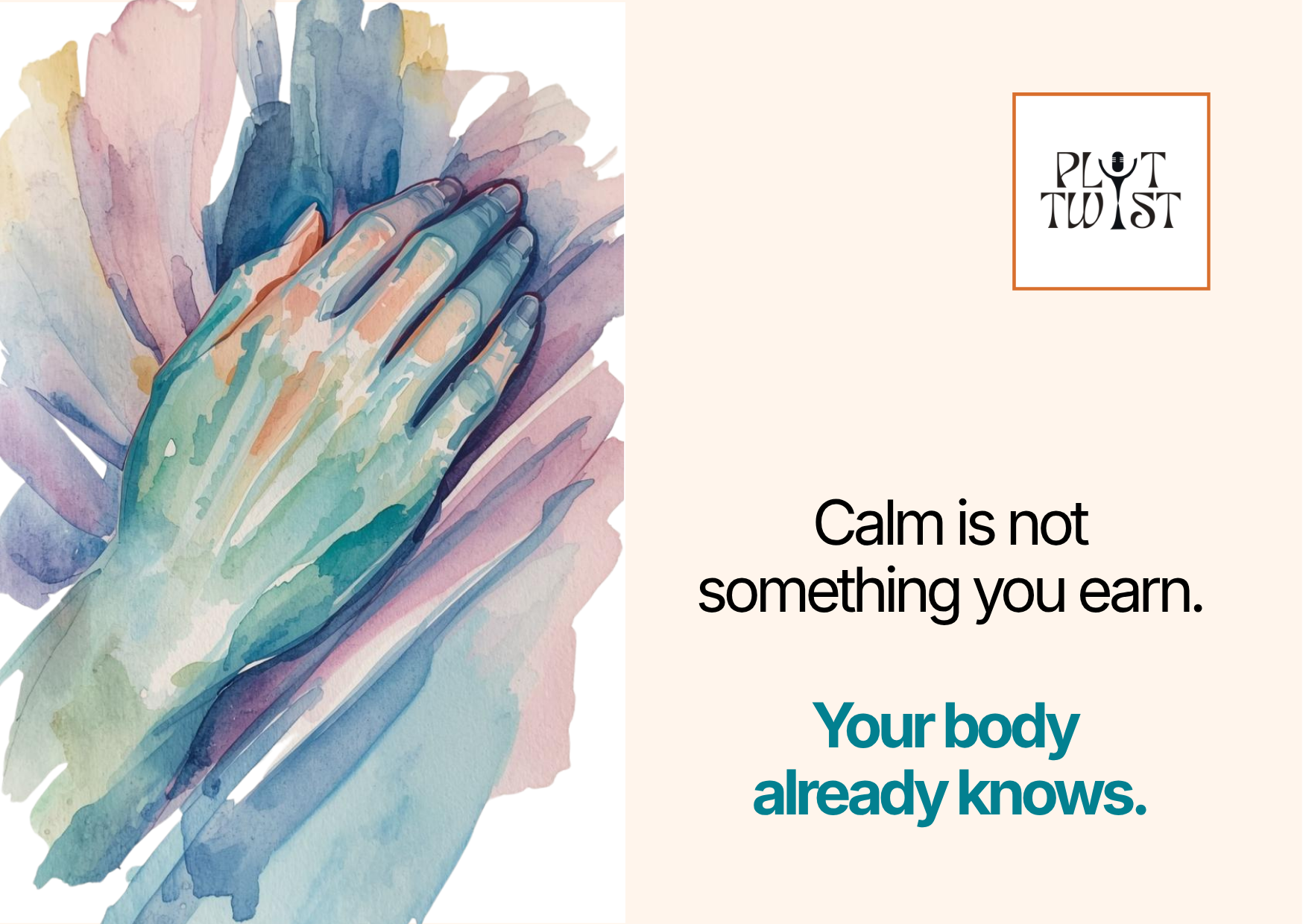
Accompanying each episode is a digital postcard, which is simply an image with a sentence or two to meet you wherever you are in your journey. You can do whatever you like with it – keep it private, share it with others, or go back and look at it to feel it. It is meant to meet you wherever you are. If you have your own stories or postcards, we would love to hear from you!