EPISODE 6
Available on:


TRANSCRIPT
Heroes Need Villains But Villains are just Villains
What if the reason your story feels so clear is because someone else became your villain? Because once they are all bad, everything else makes sense. But what if that’s not the whole story? This episode of Plot Twist is about why we vilify what it gives us and what it quietly takes away. Because maybe the plot twist is that you don’t need a villain to honor your story.
Welcome to plot twist. Today’s episode is about heroes needing villains, but villains, they’re just villains. There’s something I’ve been thinking about for a while now about how badly we all want to be the hero. And no, we don’t always announce it by riding in on our white horse, but it’s still there. The ways we want to be the good one, the reasonable one, the betrayed one.
The one who tried. The one who loved best. The one who was wronged. The one whose pain makes perfect sense. The one everyone should immediately understand and agree with. And I think what makes that so complicated as this? You can really only be the hero of a story if there is a villain. And once you have cast someone as the villain, the story gets easier to tell.
Cleaner. Sharper. More persuasive. It gets easier to explain what happened. When one person becomes all good and the other one becomes all bad. It gets easier to recruit sympathy. Easier to find certainty. Easier to make sense of the pain. Easier to know where to place blame. And maybe that’s why we do it. Because vilifying someone is not always about the truth.
Sometimes it’s about relief. Relief from complexity. Relief from embargo. Relief from having to hold the unbearable fact that someone can hurt you deeply and still be fully human. And I know that it can be a hard thing to say. It’s hard for me to say right now. I mean something quieter. And I think harder that the moment we turn a person into a villain, we often stop seeing them clearly.
I think we like the hero role because it is one of the few places where pain feels tolerable. If I’m the hero, then I do not have to wrestle with the parts of the story that make me uncomfortable. Hero stories are seductive because they simplify in simplicity can feel like safety, especially when your nervous system is desperate for something stable to hold a villainous stable a villains easy a villain gives your pain of face and a direction, and there’s a kind of selfishness in that, because once I make you the villain, I benefit.
I benefit from clarity. I benefit from the moral high ground. I benefit from the sympathy. I benefit from not having to stay in the mess of a more complicated truth. And I think that is worth admitting and seeing. Not to shame ourselves, but to understand. Because understanding the impulse is the only thing that can give us a chance to interrupt it.
I think one of the benefits of vilifying is it gives us emotional momentum. It lets us move quickly, leave quickly, talk quickly, decide quickly. Tell the story quickly. It removes friction and nuance. It removes the Sloan uncomfortable work of having to say, yes, that hurt me. And yes, there’s still a person. Yes, what they did was wrong. And yes, there may be more to them than the worst thing they did.
And yes, that does not automatically make them inhuman. That kind of thinking. It just takes more. It takes more from you and it takes more from me, more emotional maturity, more restraint, more patience, more honesty, vilifying. It’s a shortcut. It’s faster and easier. Come on. We all like those two things. Because grief, it’s complicated. Grief asks us to admit that something mattered, that someone mattered, that even in the disappointment, there may have been something real, something beautiful, something sincere.
Something that cannot be cleanly erased just because we got hurt. But if I make you the villain, I do not have to grieve with nuance. I grieve with certainty. I can say the whole thing was false. The whole thing was a lie. The whole thing was bad. There’s a problem with flattening someone. And maybe that is one of the biggest benefits of all.
If I flatten you, I do not have to feel the full dimension of what happened. But the costs of flattening are enormous. The first cost is that vilifying shrinks reality. It takes a human being with motives and contradictions and insecurities and blind spots and wounds and choices and failures, and it turns them into a symbol, a function, a role that’s not a person.
It’s just the person who hurt me. Just the one who ruined it. Just the selfish one. Just the liar. Just the narcissist. You know what? You were just the problem. And when somebody becomes a role in your story instead of an actual person of their own, you lose your relationship with reality. You’re in relationship to a character that does not mean what they did doesn’t matter.
It means you’re seeing is changed. And when our seeing changes like that, we become less human too. Because one of the things vilifying does is it trains us out of complexity. It teaches us to relate through punishment instead of understanding, and that that hurts everyone. It hurts relationships because the moment someone feels they have become irredeemable in your eyes and then repair is impossible.
It hurts communities because people stop being allowed to be flawed without being cast out of shared humanity. It hurts conversations because once someone’s the villain, listening starts to feel like betrayal. It hurts us because certainty is rigid and rigid. Things break. And maybe most of all, it hurts the truth because the truth is almost never as clean as hero and villain.
The truth is usually that somebody made choices, sometimes very bad ones, sometimes repeated ones, sometimes harmful ones that changed everything but choices that were made by a person, not a character. And I think we all know that intuitively. This is why when we see on TV Tony Soprano or Don Draper, they literally cannot be things. We’re not into their compelling.
We want to be with them. Why? They force us to sit in the harder space where someone can be destructive and charismatic, wounded and dangerous, tender in one moment and selfish in the next, capable of love and incapable of loving well. And I think that is what so many of our real life stories are missing humanness. Because when someone hurts us, it’s so tempting to strip them of every trait that doesn’t support our cause.
We rewrite them because it’s hard to admit that someone can hurt you and still have once been sincere, still have qualities that are real, even if their choices were devastating. It’s hard because once you admit that the story gets heavier, you no longer get the clean righteousness of hero versus villain. You get something more difficult loss without simplification.
And I think that’s one of the most mature forms of grief there is to be able to say, what you did hurt me deeply. I don’t excuse it. I’m not going to minimize it. I may not, but I also do not need to turn you into a monster in order to honor what happened. That’s hard. And it’s powerful because once you stop needing villains, you also stop needing heroism.
In the same way, you no longer have to be the flawless one to justify your pain. You no longer have to be pure in order to be hurt. You no longer have to curate your innocence so carefully. You get to be a person, to a person who missed things, a person who hoped, a person who loved, a person who stayed too long or left too fast or said too much or not enough.
A person who was harmed and still complicated. A person who does not need a perfect role in order for their pain to count. That feels important to me, because heroism can become its own trap. If I have to remain the hero of every story, then I have very little room. To be honest, I can’t admit ego. I can’t admit the moments I wanted to be chosen, preferred and admired.
I can admit that sometimes I didn’t just want healing, I wanted to win. And I think more of us want to win than we’re comfortable admitting. We want the breakup where everybody knows who was right. Okay, there’s clearly a good side and clearly a bad side. We want the conflict where everybody sees our goodness clearly. We want the ending where our pain gets translated into moral authority.
We want the story to confirm that we were the loving ones, the wise ones, the evolved one and the innocent one. And maybe that’s understandable, but it’s also expensive. Because when winning matters more than understanding, we stop relating to people and start managing optics. We start shaping stories not only to reflect what happened, but to secure the role we want in the retelling.
And that’s where vilifying becomes really dangerous, because it turns storytelling into a weapon not always outwardly, sometimes internally, but a weapon all the same. It allows us to freeze another person at the sight of our pain. No movement for them, no context, no possibility of being more than what they did to us. And I think the deep cost of that is much more than emotional.
It could even be spiritual because to deny someone else their humanness is to weaken your own relationship to humanity itself. Not in a dramatic, saintly way, just in the simple sense that every time we make a person less real, in order to make a story more satisfying, something in us has to harden. Something becomes flatter, meaner, less alive.
I have a brother. In the last ten years, I can see the weight of what should have been there in our relationship. I feel what was missing and I have sadness, not just anger. I ended up exhausted, strained, spent, completely overextended. I think it’s going to be easiest if I get you there through a timeline. July 2015. Many of you know my dad died.
I was supposed to pick up his ashes at the funeral home and they gave us a time window. So I asked my brother if he’d meet me there so that I didn’t have to do it by myself, so I waited. I got there at the start of the window, and I waited the full two hours. He never came.
To make matters worse, I called him, I texted him, I continued to reach and he never admitted to me he wasn’t going to be there. So finally it got too late in the day and the funeral home said to me, you’re going to have to take your father’s ashes with you. Like we can’t just leave them here. And so I realized this was all me.
So what do you do when you pick up ashes? I wasn’t really sure. So when I walked my dad to the car, I decided that he should obviously be seat belted. I mean, that seemed very reasonable to me. And then I was going to put him in the passenger seat. But he always did that thing with the door where they grab onto it with dear life while you’re breaking.
So I decided, you know what? I think right behind the driver’s seat was the right place for him. I buckled him in when I got to my parents house. I was willing, as that garage door opened to see the car that my brother and mother had been in that day, empty. No car there. So now I realize I’m going to do this whole journey by myself.
Don’t worry. I gave him the play by play dad, I’m just taking you out of the car and we’re walking into the garage. We’re now in the house. Don’t worry. I let him know where we were and what was going on. I then made a decision that he belonged on his dresser in his bedroom. Why is that? My dad loved his stuff.
And if a guy loves his stuff, you should keep him on the dresser. So that was the first point in the timeline. Next we come to the fall of 2021. My mother had gotten diagnosed with bladder cancer and she needs a series of chemotherapy. I believe it was 12 weeks. My brother had agreed in talking to my mother that he would take the first six weeks of care with her, and that I would come in for the last six weeks.
Within 48 hours. He leaves. He can’t do it. Does he let me know? Does he set up some sort of care in another way to cover the bridge? Absolutely not. So I get the phone call from my mother, who’s going through her first chemo, now on her own, and I have to uproot my life and now take on all 12 weeks of her care while I’m running a startup and trying to balance my life, the necessities of it, and even caring for a special needs dog on top of everything else.
Fast forward to September October 2023, and I am single handedly left to gut our childhood home. My parents had hoarded it since 1988, and literally I needed to move my mother to her forever community because of her health and the support I got from my brother during that time is him telling my mother that she didn’t need to leave that home, and that she didn’t need to go to a community.
Now he’s essentially against me. And then finally, in the timeline in November of 2020 for Thanksgiving, my mother had to have a surgery on the Wednesday before the holiday, and it went very badly. She ended up in the ICU, and I think we all know who spent Thanksgiving alone in the ICU. For the sake of irony, my brother does decide to FaceTime.
Don’t worry, they’re in a great place. Suntan smiling, him and his family glowing ear to ear about the beautiful Thanksgiving Day they’ve had were literally. I’m sitting wondering if my mother’s going to live. He transferred all the costs to me. I supported my mother alone for years, and honestly, to this day, I handle the crises. I do the logistics, I carry the emotional weight and it was hard.
It took something from me. I’m making it through. I gave and gave and gave. I stretched myself well beyond what was sustainable and when I finally came up from it, I recognized what it took out of me being in a role of constant care, empathy, emotional labor. Those qualities got overused to the point of depletion. Not because those qualities are weak in me, but because they were relied on too heavily without reciprocity.
My brother didn’t show up. I carried everything alone, and that shaped how I saw him and how I saw myself for a long time. I needed him to be the villain so I could make sense of why I was carrying everything alone. I thought it was something for carrying it all. The prize was I left myself and I didn’t even know that I’d done it.
I thought I was being good, I thought I was doing right, the good daughter. But now I’m learning my way to come back. Not all at once and not perfectly, but just with a little more kindness that I’ve ever given myself before. I’m still asking myself, what did it mean? Even as I’ve evolved, part of me is still stuck there.
So maybe my plot twist is maybe heroes need villains when there’s no repair. Maybe we create those rules to hold what hasn’t been ignored. Before we get into the narrative section where we examine potentially keeping, revising, or retiring, I just want to say this is not a call to change. It’s not a demand for what hurts or to rush into a more generous story before you’re ready.
This is just a moment of recognition, a little more grace. And to remember that just because a story helped us carry something doesn’t mean it’s the only way to carry it now.
I got two of my keep piles today. I’m allowed to feel hurt or disappointed because I am. Because of my feelings. They don’t need a villain to exist. They just need space to be felt. I’m also keeping what happened to me matters, because I don’t need to exaggerate or simplify the story for it to count as my experience. It’s real on its own.
Next, I’d like to revise. I’m revising from. If they hurt me, they must have never really cared. Two, someone can care for me and still hurt me in ways I cannot continue to hold. Okay, I love a good rewrite, especially when someone hurts me. So this one hits me hard. We want the ending to be the whole story, but often the truth is harder than that.
Sometimes the care was real and the hard and hurt was real. To revise this lets us stay honest about what happened without flattening the whole relationship. Next, I’m going to revise from. If I tell the story with nuance, it’ll sound like what happened to me did not matter. Two nuance does not weaken the truth, it deepens it. I think this is a really important one.
We often fear that complexity will dilute our pain, that if we admit someone is human, flawed, scared, limited, or complicated, then somehow we’re letting them off the hook. Revising this helps us tell the truth more fully, not less clearly. And retire. I got two for today. For me to be the good one, someone else has to be the bad one.
I’m no longer telling the truth as much as I’m protecting a role, and I’m also retiring. Once somebody hurts me, the worst thing they did becomes the truest thing about them. I got to retire this narrative because it lets me stay clear without being cruel. So how do we begin to see the Tony Sopranos and Don Drapers that are in our very lives for who they are?
Maybe first, it’s by resisting the impulse to summarize someone to quickly, by noticing when our language becomes total. Always, never. Everything. Nothing. Pure manipulation. Pure selfishness. Completely fake. Entirely bad. Maybe we should begin by asking a different question. What choices did they make and what did those choices cost? You know what? That question. It keeps accountability intact. It doesn’t dissolve harm into empathy.
It just shifts the focus from identity to behavior. And that matters. Sometimes a person made a catastrophic choice. Sometimes they made 100 small ones. That slowly became a life altering pattern. Sometimes they kept choosing themselves at someone else’s expense. That’s one I know well. Sometimes they were careless in ways that were devastating. Sometimes they lacked maturity, honesty, courage, or self-awareness to even do better.
Those things matter. Naming them matters, but naming them is different than creating their own mythology. To say, you hurt me, you failed me. You lied. You abandoned what matter? You did not care for this or me. Well, you made choices I cannot continue inside of. I think one of the hardest things to accept is that sometimes the villain in our story is just a person who made a big mistake, or a series of media mistakes, or a thousand small ones.
A person who is avoidant, a person who is selfish, one who was scared, an immature one who wanted to be loved and was unwilling to be honest. That doesn’t make the damage smaller, but it does make the person real again. And I think reality is always more useful because reality it can help us heal. Reality helps us to set better boundaries.
Reality helps us discern patterns. Reality helps us to see what actually happened. It helps us avoid repeating the story, not just retelling it more dramatically. And maybe that’s another cost of vilifying. It can keep us attached to the performance of pain instead of understanding it. If I keep you as the villain, I may never have to move beyond the version of myself that was injured by you.
I may never have to ask what else is true now. Never have to let the story become less satisfying and more honest. And I may never have to release the identity that came from being wronged. And there’s a strange loyalty in that, a loyalty to the clarity the story once gave us. Even after that, clarity has started to cost us our openness, our softness, or our range.
I do not think the answer is to stop naming harm, and I do not think the answer is to force compassion or it is not honestly arrived yet. Maybe it’s just to leave a little room, a little room for the fact that most people are not archetypes, a little room for the possibility that someone can be deeply disappointing without being deeply unreal.
A little room for the understanding that your pain does not become less valid just because the other person remains human. Maybe the plot twist is we do not need villains as much as we think we do. Maybe we need to tell the story in a way that honors what actually happened. We don’t need the villains because the villains gave us a role, and sometimes a role costs more than it gives you, because the plot twist is that the person who hurt you was not a villain.
Maybe they were just a person who made choices that changed your life, because once you let go of hero and villain, something else becomes possible. Discernment without dehumanizing truth without performance. They’re just people. People with charm and cowardice, need and ego, tenderness and selfishness, capacity and limitation. People who sometimes do damage they can never fully undo. And that reality that’s harder to hold.
But it’s also more humane because when we stop needing villains, we also stop organizing our lives around proving we were and still are the hero. We can become more honest about them, about ourselves, about what happened, about what the cost is and about what is still true. And maybe that’s enough. Maybe enough is you hurt me. It mattered.
I see it clearly. I will not excuse what should not be excused, but I will also not reduce either of us to just a role and make the story easier to carry that. That feels like a different kind of power, not the power of winning the story, the power of not needing to win. And maybe that’s the final plot twist.
Take what’s yours. Leave what’s heavy? The twist. It’s you.
afterward

Heroes Need Villains But Villains are just Villains
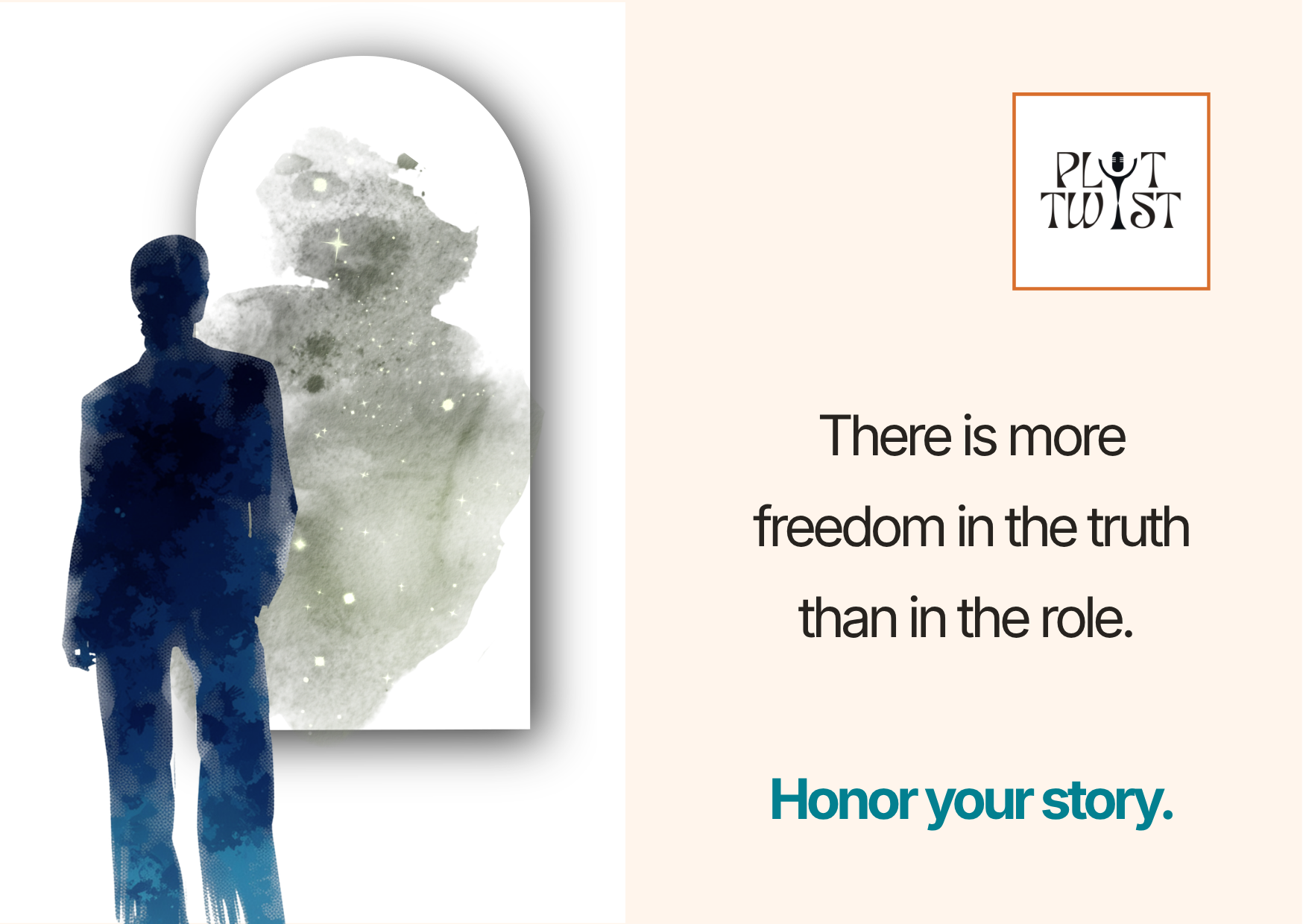
Accompanying each episode is a digital postcard, which is simply an image with a sentence or two to meet you wherever you are in your journey. You can do whatever you like with it – keep it private, share it with others, or go back and look at it to feel it. It is meant to meet you wherever you are. If you have your own stories or postcards, we would love to hear from you!