EPISODE 3
Available on:


TRANSCRIPT
Are you a Dopamine Hostage?
Are you a dopamine hostage? And who is your captor? On this episode of Plot Twist, I’m exploring our bias towards instant gratification and the deeper patterns that keep us hooked on relationship intensity, productivity highs, and intermittent reinforcement. But you know what the hardest truth is in this episode? The captor. They might not just be out there. It may also be the part of us that keeps choosing immediate relief over long term freedom.
Maybe the hostage and the captor live in the same body. Ours. Because sometimes the cage is not built in one dramatic moment. Sometimes it is built choice by choice, reward by reward, and yes, by yes. Sometimes the cage is made of choice is so small we barely notice we’re building it.
Are you a dopamine hostage? And maybe even more importantly, who is your captor? At first the question seems super easy to answer. We are going to point outside ourselves. We blame the phone, the notifications, the algorithm, the sugar, the shopping, the endless scrolling, the culture of convenience. The world keeps teaching us to want more, faster. And now. And to be fair, those things absolutely matter.
We are living in a world designed to capture attention, trigger our cravings, and reward immediacy. We’re surrounded by systems that know exactly how to keep us stimulated, activated, and coming back for more. But the longer I sat with this question, the answer started to change. Because yes, there are external forces competing for our minds. Yes, modern life knows how to exploit our reward systems.
Yes, dopamine gets pulled into all of it. But you know what? What if the captor is not just the thing tempting us? What if the captor is also you? What if the captor is the version of you that keeps choosing immediate relief over long term freedom? The version of you that keeps saying yes to what sues you now, even when it costs you later.
The part of you that knows better but you reach anyway. The part that confuses craving with a need. Intensity with love and productivity, with self-worth. Because maybe being a dopamine hostage is not just about brain chemistry. Maybe it’s about what we repeatedly run towards when we’re uncomfortable, uncertain, lonely, bored, anxious, or feel like not enough. Maybe it’s about the ways we participate in our own captivity.
And that’s where this gets personal. Really personal. Because this pattern does not always show up in obvious places like our phones, our snacks, and our shopping carts. It also shows up in our relationships. It shows up at work, and it shows up in one of the most powerful psychological hooks we rarely talk about by name. Intermittent reinforcement. Oh, it’s the Voldemort of psychology 100%.
When I first started thinking about this idea of being a dopamine hostage, I imagined the captor is something outside of me. All the usual suspects came to my mind. And yeah, those things are powerful. They do know exactly how to pull on the brain’s need for pleasure, relief and reward. We didn’t become dopamine hostages overnight. It happened slowly.
We kind of need to start at the beginning. So first there were dinosaurs, and then they all died. Okay, maybe not that beginning, but in all seriousness, first, dopamine helped us survive by rewarding behaviors that kept us alive and connected. Survival of the fittest. Dopamine bears, dopamine villages. Dopamine. Then the modern world figured out how to press that button constantly.
Notification sugar, endless content, impulse buys, validation on demand. All of it started training us to expect quick rewards and immediate relief. And somewhere along the way, what was once a healthy motivation system became something many of us now serve. We became dopamine hostages when a normal survival system met an environment built to overstimulate. Dopamine itself is not a bad guy.
It’s a part of the brain’s motivation and reward system. It helps us notice what feels important, rewarding, novel, or potentially useful. And it’s a push. It pushes us to move towards it. It helped humans survive. We sought out food, connection, safety, sex achievement and learning. The problem is the brain was shaped for a world of scarcity. But now we live in a world of abundance, convenience and engineered stimulation.
So how we got here goes something like this. First, dopamine helped us survive. We needed a system that rewarded us for doing things that kept us alive. Find food. Feel good. Belong to the group. Feel good. Solve a problem. Feel good. The reward loop made us repeat useful behaviors. Then the modern world learned how to trigger that system constantly.
Phones, apps, add processed foods, online shopping, streaming, gambling, notifications, porn, even inboxes. All of them offer quick reward, novelty, anticipation, or relief. They hit the same system again and again. Then we got trained and now we prefer fast stimulation. So reward is always just one tap away. So now patience feels unnatural. Uncomfortable. Honestly, patients never felt natural to me, but I think mine is getting worse.
Waiting feels empty. Silence. Uncomfortable. Boredoms unbearable. The baseline is shifted. Then reliefs becomes addictive too. We’re not just chasing the pleasure. We’re chasing the escape. We use dopamine triggering behaviors to avoid discomfort, stress, loneliness, insecurity, uncertainty, sadness, and boredom. So we’re not only now seeking reward, we’re self-medicating with a heavy dose of distraction. And then the habit loop.
It gets deeper and deeper. Let’s keep it up. Craving. Response. Reward. Craving. Response. Reward repeated enough times and it starts to feel automatic. You’re not even choosing it. You just reach. You don’t think. And that’s I think when it starts to feel like captivity, at least for me. So the trap was built by modern life, but it got reinforced by our personal choice.
We become dopamine hostages little by little. Every time we teach ourselves that discomfort must be escaped immediately. So today, I want to talk about where this captivity can hide in plain sight. In our personal lives, captivity can look like addiction to intensity. Then where does that captivity show up? Most clearly for me, two places how I love and how I work.
Some of us did not just fall for people. We fell for the feeling, the anticipation, the uncertainty. We call it chemistry, passion or connection. But sometimes the real name for it is something very different. Instability. That is what makes this pattern so tricky. Intensity can feel profound. It can feel consuming, even alive. But intensity, I’ve now learned, is not always intimacy.
In fact, sometimes intensity keeps us from real intimacy because we become attached to the chase rather than the peace of actually being known and being safe. And sometimes what keeps us attached is not the person, but the emotional highs and lows that they create in us. And this is where our own capture piece matters. Because even if someone else is inconsistent, unavailable, or emotionally chaotic, at some point we have to ask, why do I keep choosing what dysregulated me?
Why does calm feel boring to me? Why does uncertainty feel like love? I was freshly divorced and my mom had been diagnosed with bladder cancer. I went to Cleveland directly from my vacation to Portland as of course, my flight back home to Richmond had been canceled. I had extra time then to just be visiting and waiting for the surgery in Cleveland, and I decided to text her physician.
What, you’re texting your mother’s surgeon? Okay, so I’d met him briefly a few years prior, and he had asked me for my cell phone number, and he texted me an odd selfie of him in a tank top. He’s not naturally predisposed to look good in a tank top, if you know what I’m saying. And it was the weirdest, weirdest setting.
He’s in the Metroparks cycling. Anyway, getting back to where we were. So he and I decided to meet for dinner the next evening at the nicest restaurant in my mom’s town. And that’s how it all began. I had no idea I was unleashing my first strips of a dopamine hit. The dinging of the text from him felt so good.
I’m gonna be honest. I wanted more, more, more when he and I could. We kept that dopamine flowing freely with constant texting back and forth. What a high. And then we would each have to go silent. Oh, now we’re starving. And so when we could, we push that upper bound so high. It was the first time I experienced the maybe of it and reinforcement, and I was hooked.
In my personal life, this romance was kept as an addiction to intensity. I didn’t fall for him. I felt for the response. And I thought intensity was intimacy. So I was addicted to the person, but I was addicted to the emotional spikes that he created. Maybe at some point you’ll recognize this in yourself, and if you do, let it be enough; if it resonates, you’re not alone.
It was my first job out of college, and I was young, even younger than typically coming out of undergrad, as I graduated in three years with a double major. So I was young. For young, my obsession became Post-it notes, different colored pens, and the pure satisfaction of crossing items off the list. I had disguised my productivity-based dopamine heads as a fondness for office supplies.
I would come in at, oh, I don’t know, 5 a.m. I’d stay until 8 or 9 p.m. all in the worship of the list. Really, what I was worshiping is the feeling of completion. The are. There was nothing better than it. Not even my Marlboros. And that’s saying something. As I was trying to quit. I did not realize it at the time, but I was just trading one addiction for yet another.
But my new one was not just socially acceptable, it was socially rewarded. Even better. Professionally, the captivity can look completely different and a lot more socially acceptable and even rewarded. Here. The trap is not a relationship which at times could appear messy from the outside. It’s productivity, the rush of getting things done, clearing that inbox, hitting the deadline, being praised, being needed, being the person who always delivers.
And on the surface it looks admirable, responsible, successful. But underneath there can be that same reward loop pursuit, payoff crash. Repeat. For some of us, productivity becomes more than work it did for me. It became my identity. It became my emotional regulation. It was a place I went to feel in control, important, validated, and finally enough. And again, the capture is not just the job or the culture.
It’s the part of us that keeps tying our worth to our output, the part that doesn’t know how to rest without guilt, the part that feels most lovable when performing, producing or proving. But underneath it, sometimes there’s a quieter truth. Some of us are not addicted to productivity itself. We’re addicted to what productivity makes us feel. That’s why productivity highs can be so deceptive.
They’re rewarded, they’re praised, and they’re mistaken a lot of times for ambition. But sometimes they are just another form of captivity, one in which the cage looks just like achievement. Underneath both of these patterns is one of the most powerful psychological hooks of them all. I set it earlier. Intermittent reinforcement, I know, is that it? A second time we become attached to what keeps us activated, keeps us reaching, what keeps pushing us on the next hit of validation, relief, reward or meaning.
That’s what happens when the reward is inconsistent. Not when it’s absent, not when it’s constant, just unpredictable. And strangely enough, that unpredictability can make us even more attached. That’s why slot machines are so addictive. Maybe I do have something in common with my mother. That’s why inconsistent texting can keep somebody obsessing. Why random praise at work can make you want to overextend yourself again and again.
It’s why social media is so hard to put down the reward. It comes just often enough to keep you open. And there’s the trap. Because we’re not always captured by what feels good consistently. Sometimes we’re captured by what feels good occasionally. For me, it’s the maybe the possibility, the promise, the next scroll, next message, next accomplishment, next breakthrough might finally be the one that gives me what I’m craving because the brain gets hooked on the maybe.
Maybe this time I’ll get the text. Maybe this time the work will finally make me feel fulfilled. Maybe this time the reward will be enough. Maybe is a powerful drug. And this is where captivity gets really subtle, because we do not always stay attached to something because it’s good. Sometimes we stay attached because it’s good, just often enough to keep the hope.
That’s what makes intermittent reinforcement so dangerous. And instability can be so compelling. And once again. Yes, there may be an outside system setting the trap, but we keep returning to it. We tighten it when we keep saying yes to what spikes us instead of what actually studies us.
I want to pause here and listen for stories underneath the ones that have made intensity feel meaningful, urgency feel necessary, and my captivity feel familiar. This is not about judgment. It’s about recognition, permission, and grace. So let’s ask ourselves, what do I keep? What could I revise and what may be served me well, but I could retire. I’m going to start with my keep.
Pleasure is a good thing. Unconscious pursuit is not. Pleasure is not the problem. Pleasures human and wanting to feel good as human. The problem comes in with the unconscious pursuit part. Pleasure is beautiful, it’s nourishing, and it is part of being fully alive. But when I chase it without awareness, without restraint, without asking what it is replacing, or the most important, what it costs me, that’s when it turns from experience to captivity.
Another keep my cravings are information, but they’re not commands. I want to honor dopamine. It made us survive. It protects me. It brings forward my cravings. And I need to know those right? But they do not get to run my life. I don’t have to obey dopamine blindly, nor does it automatically deserve action. Revise. I’d like to move from intensity means love to intensity can feel powerful, but intimacy is built on safety, consistency, and truth.
What I know now is that intensity may create adrenaline, obsession, or anticipation. But intimacy is something else. Intimacy is consistent, safe, honest. There’s peace in it. I’d like to move from my worth. Comes from what I produce to my work. Can express my value, but is not the source of my worth. My work does demonstrate my gifts, my effort, even my discipline.
But it’s not the source of my worth, so my value doesn’t disappear when I rest. Now I’m going to move on to retire. Although these narratives served me very well, at some point, I do think I’m ready to retire the first one. If I want it badly enough, it must be right for me. I’m retiring this as it feeds dopamine, captivity everywhere.
Relationships, work, shopping, validation, scrolling. Wanting something intensely does not mean it’s good, healthy, aligned, or loving. Set another way I want to return my belief that desire is always wisdom. Sometimes wanting is just wanting. Sometimes craving is not guidance, it’s conditioning. I’m also going to retire. Discomfort means I need relief right now. This belief keeps me trapped in compulsive soothing.
It taught me that every discomfort is an emergency, but a lot of freedom comes from learning that discomfort can be tolerated, observed, and survived without immediately obeying it. So I’m retiring the narrative that every discomfort needs an immediate answer. Not every craving deserves a response. Not every urge is an instruction. Just knowing that your story is editable is already a plot twist.
And that is more than enough. Maybe the hostage and the capture can live in the same body. Maybe the captor isn’t just dopamine, not just the app, the job, the relationship, the algorithm, not even just the world. Maybe the capture is also the self that keeps surrendering to what feels good now, even when it creates hunger later. The self that chooses intensity over intimacy, output or their worthiness.
Unpredictability over peace. Relief over freedom. And I do not say that with shame. I say it with honesty because if I helped build the cage, then maybe, maybe I can also stop living in it. And maybe my freedom begins there. And so to Shaw’s not with blaming ever external force that pulls on us, but with the recognition that moments that we hand ourselves over, the moments where we trade our piece for a spike or a future, for a feeling of freedom, for a familiar pattern.
Maybe we became these dopamine hostages because he lost our tolerance for stillness. We got addicted to pursuit and forgot how to feel okay without the chase. We know how to want, but not how to rest. We know how to stimulate ourselves, but not how to satisfy ourselves. We keep mistaking stimulation for fulfillment. Dopamine about the chase, the anticipation, the craving, the pull.
And it’s always just out of reach. What we want. But serotonin, it points us towards something different: steadiness, satisfaction, the ability to feel okay without constantly needing to move. And maybe that’s part of the problem. A dopamine hostage is always chasing. A serotonin centered life might look more like presence balance and enough. And we could ask ourselves the bigger question: am I actually happy or am I just repeatedly stimulated?
We stay not because it’s good every time, because it is good just enough. I don’t want just enough. So maybe the opposite of being a dopamine hostage is not having no desire at all. Maybe it’s rediscovering serotonin not just as a chemical, but as a state of being, a steadier kind of well-being, a life that doesn’t depend on constant hits of novelty, validation, or escape.
Because there’s a difference between feeling activated and feeling at peace. One keeps you chasing the other. It lets you arrive. We need both. Of course. We need drive, motivation, desire, and pursuit. Thank you. Dopamine. But when life becomes all chase and no peace. All wanting and not enough, that’s when we start feeling captive. Dopamine helps us pursue serotonin, helps us feel okay when we arrive.
The problem is modern, like keeps us stuck in pursuit mode, constantly activated, constantly reaching. We’re always looking for the next thing, and when we lose, every reward becomes temporary. We’ve lost contentment. Dopamine says there’s something out there you need. Serotonin says you’re okay here. Dopamine pulls forward into pursuits. Serotonin anchors us enough. But a life built only on dopamine will always feel hungry.
At some point, real freedom might be learning how to stop chasing long enough to feel whole, whether it’s intensity in relationships, productivity at work, or the general hook of intermittent reinforcement, the patterns are always the same. We become attached to what keeps us pursuing, what keeps us activated, reaching for relief, validation, or reward. And at some point, the deepest captivity is not just that these systems exist.
It is that we keep participating in them, choosing the spikes. Somewhere along the way, we mastered stimulation and neglected contentment. We became fluent in the chase, the hit, the next scroll, the next win, the next relief without learning how to live inside enough. And that’s what instant gratification does. It offers temporary relief with delayed consequences. It sues us, but only for a moment, and then ask for something back later, because the chase can make you feel alive.
But peace is what makes you feel free, and that may be the real plot twist. The captor is not only the thing outside of us, it is also the part of us that keeps saying, yes, you also don’t have to live at the mercy of what pulls you. Take what’s true, leave what’s heavy. The rest can wait. The twist. It’s you.
afterward

Are you a Dopamine Hostage?
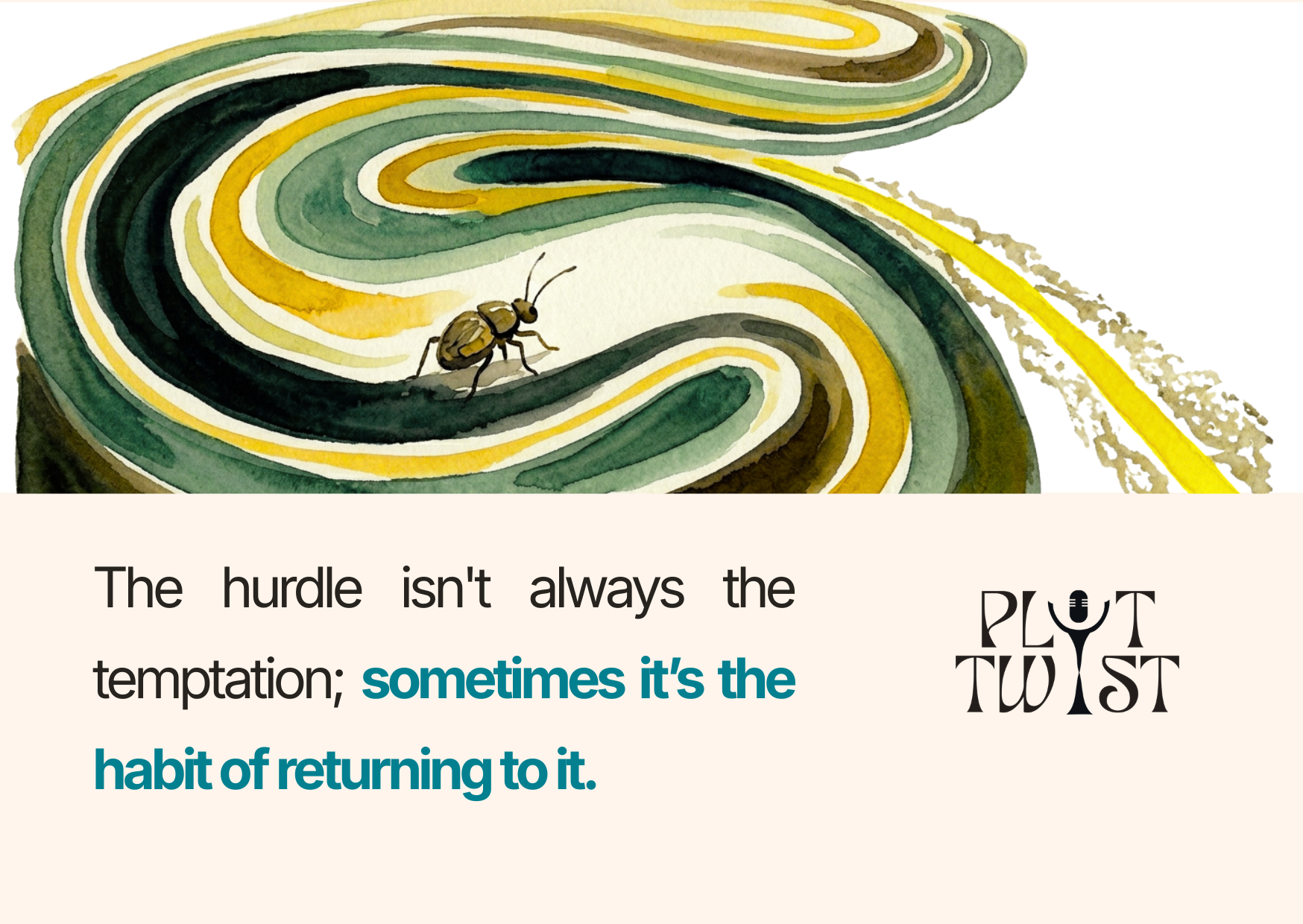
Accompanying each episode is a digital postcard, which is simply an image with a sentence or two to meet you wherever you are in your journey. You can do whatever you like with it – keep it private, share it with others, or go back and look at it to feel it. It is meant to meet you wherever you are. If you have your own stories or postcards, we would love to hear from you!